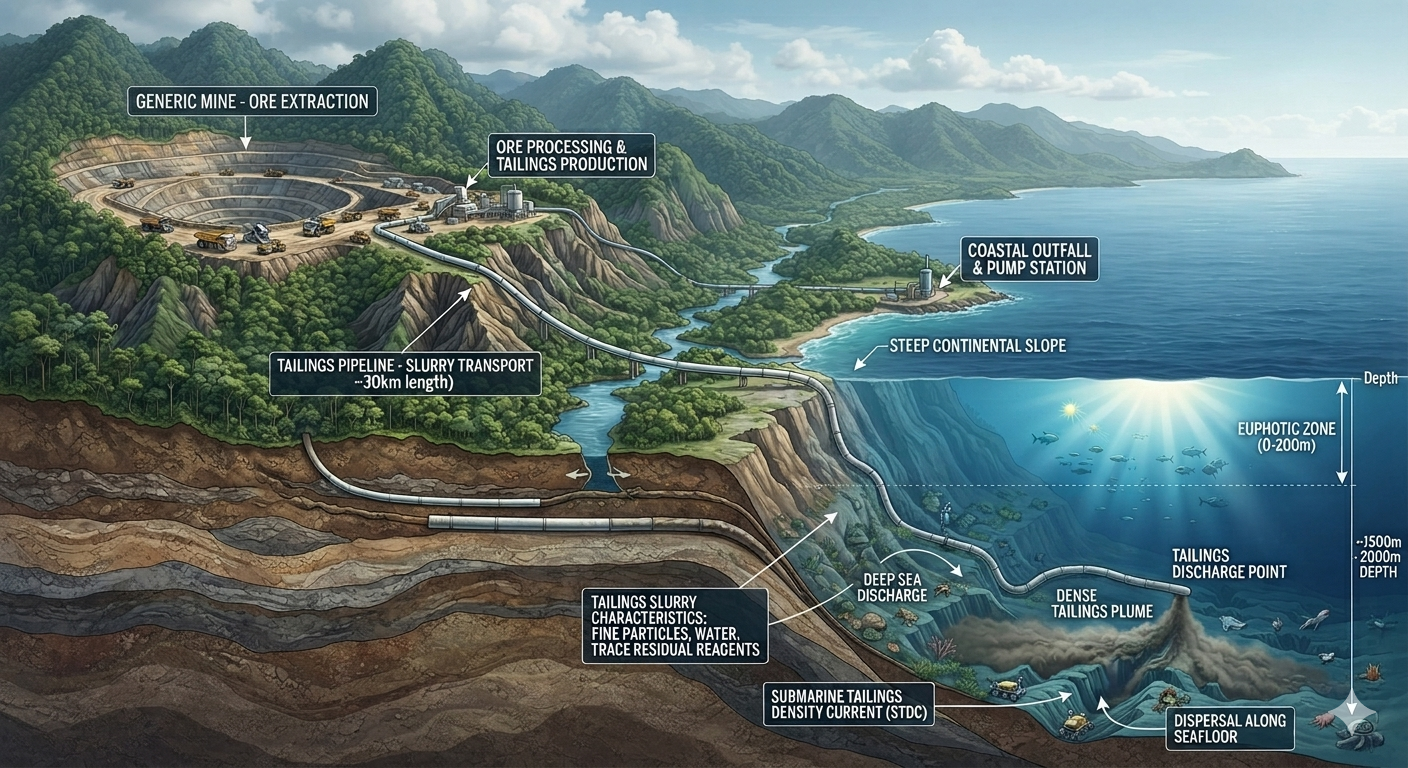
Papua New Guinea’s Wafi-Golpu copper-gold project has re-entered the national spotlight, with Prime Minister James Marape pushing to finalise the Mine Development Contract (MDC) and Special Mining Lease (SML) as early as this year (2026) [1]. But the project’s proposed method of tailings disposal — piping mine waste 103 kilometres from the Morobe Province site to the Huon Gulf and releasing it into the sea — remains its most contested feature [2].
The Opposition Case
Deep Sea Tailings Placement (DSTP) has drawn sustained opposition from civil society and church groups for more than a decade. The Evangelical Lutheran Church of Papua New Guinea reaffirmed at its January 2026 synod its opposition to the project’s DSTP plan, framing it as a matter of moral duty of care for both people and the environment [2]. Critics also point to the pipeline’s route, which reportedly runs through populated areas of Lae city before reaching the ocean outfall [2].
Community concern has translated into litigation. Local communities in Papua New Guinea filed a legal challenge to the environmental permit granted for Wafi-Golpu, arguing it did not adequately account for the environmental harm associated with deep sea tailings placement [3]. That case has gone to PNG’s Supreme Court, which is deciding whether community concerns over marine tailings dumping justify cancelling the environmental permit the government issued in 2020 [4]. Residents in the Huon Gulf say they rely on near-shore fisheries and were not adequately briefed on the risks to sediment and marine chemistry before the permit was issued [4].
WGJV and Government Case
Wafi-Golpu Joint Venture (WGJV) — jointly owned by Newmont and Harmony Gold — maintains that DSTP is the safer of the available options, not an expedient one. The companies argue that transporting waste to the sea is less harmful to people, environment and cultural heritage than disposing of it on land, and that properly placed tailings would not affect the marine life the Huon Gulf’s communities depend on, since the waste would be released deep in the water column, below the layer most important to fish stocks [4].
This position is grounded in the project’s own feasibility work. WGJV’s updated feasibility study identified deep sea tailings placement as the preferred tailings management method after assessing forty-five potential sites for land-based storage [5]. That land-based assessment found that the required storage footprint would carry high traditional heritage and biodiversity value, could displace communities, and would sit in an area of high seismicity with complex, active faulting that risked liquefiable soils — factors the study said would require high-cost, high-risk engineering to manage [5]. In other words, WGJV frames the marine option as the lower-risk trade-off given Wafi-Golpu’s steep, seismically active terrain — a claim independent of the pipeline routing and community-consultation concerns raised by opponents.

Credit: Wafi-Golpu Joint Venture [10]
On the environmental permit itself, it was issued by the PNG government in 2020 under the Environment Act 2000 framework administered by CEPA. Government commentary on Wafi-Golpu since then has centred less on the tailings method and more on securing commercial terms — though it implicitly endorses the project proceeding as designed.
The Economic Case
For the State, the calculus is significant. Prime Minister Marape has said the project holds more than twelve million ounces of gold and three million tonnes of copper, positioning Wafi-Golpu as one of the country’s largest prospective mines [6]. The government has tied its support to a specific benefit-sharing target: every major resource project negotiation under Marape’s administration has been driven by the principle that PNG beneficiaries must receive at least 55 percent of total benefits, through royalty, equity and tax [7]. The State is seeking 30 percent equity in the project, and Marape has invoked the Lihir Gold Mine — where he says the state received limited corporate tax revenue despite high gold prices — as the precedent his government wants to avoid repeating [11].
Marape has also framed the project as macroeconomic, not just fiscal. He has pointed to capital inflows during construction as a way of easing the country’s foreign exchange constraints and other economic pressures, and has linked Wafi-Golpu with the Frieda River project as anchors for mining development in PNG’s north, alongside Papua LNG and P’nyang LNG in the south [8].
The Implications
The DSTP dispute is not simply an environmental-versus-economic binary — it is also a dispute over risk comparison. WGJV and its critics are answering different questions: the company is comparing marine disposal against the risks of land-based storage on unstable, seismically active terrain; opponents are comparing marine disposal against the status quo of no disposal at all, and questioning whether consultation adequately captured community risk tolerance. Both arguments can be internally consistent while pointing to opposite conclusions — which is precisely why the Supreme Court case, not the MDC negotiations, may prove the more consequential process for how PNG regulates tailings disposal at future projects.
References
- Department of Prime Minister and National Executive Council (2026). “Prime Minister Marape Confirms Papua LNG and Wafi-Golpu Projects Advancing Toward Next Development Phase.” https://www.pmnec.gov.pg/prime-minister-marape-confirms-papua-lng-and-wafi-golpu-projects-advancing-toward-next-development-phase/
- LCA News / Jubilee Australia. “Papua New Guinea: Mining Project Sparks Fears of Environmental Disaster” / “Media Release: Wafi-Golpu Pushes Ahead, Ignoring OECD AusNCP.” https://www.lcanews.com/en/papua-new-guinea-mining-project-sparks-fears-of-environmental-disaster/ ; https://www.jubileeaustralia.org/news/latest-news-post/media-release-wafi-golpu-pushes-ahead-ignoring-oecd-ausncp
- Mongabay (13 June 2025). “‘It’s our garden’: PNG villages fight to prevent mine waste dumping in the sea.” https://news.mongabay.com/2025/06/its-our-garden-png-villages-fight-to-prevent-mine-waste-dumping-in-the-sea/
- Business & Human Rights Resource Centre. “Papua New Guinea: Local communities file lawsuit challenging approval of marine tailings dumping.” https://www.business-humanrights.org/en/latest-news/papua-new-guinea-local-communities-file-lawsuit-challenging-approval-of-marine-tailings-dumping/
- Wafi-Golpu Joint Venture (2018). Updated Wafi-Golpu Feasibility Study Press Release. https://minedocs.com/17/WafiGolpu_Feasibility_Press_03192018.pdf
- The PNG Sun (3 October 2024). “Wafi-Golpu Mine Project Crucial for Fixing Economic Issues: PM.” https://www.thepngsun.com/wafi-golpu-mine-project-crucial-for-fixing-economic-issues-pm/
- Department of Prime Minister and National Executive Council (2025). “Prime Minister Marape Emphasises Commitment to Securing Maximum Benefits for PNG in Wafi-Golpu Mine Development.” https://pmnec.gov.pg/prime-minister-marape-emphasises-commitment-to-securing-maximum-benefits-for-png-in-wafi-golpu-mine-development/
- Department of Prime Minister and National Executive Council (2026). “Prime Minister Marape Affirms Strong National Interest in Wafi-Golpu and Papua LNG Projects.” https://www.pmnec.gov.pg/prime-minister-marape-affirms-strong-national-interest-in-wafi-golpu-and-papua-lng-projects/
- Papua New Guinea Environment Act 2000 https://lpr.adb.org/resource/environment-act-2000-papua-new-guinea
- Wafi-Golpu Joint Venture (28 October 2020). “Wafi-Golpu Project: Tailings Management Facts.” https://static1.squarespace.com/static/576cc5cb4402430e8c118af2/t/5fa9e3d344651c560229c955/1604969442143/201028+WGJV+Stakeholder+Letter+Key+Facts+Tailings+Management+DSTP++-+GENERIC.pdf
- The National (19 March 2025). “Wafi-Golpu talks to end in September: Marape.” https://www.thenational.com.pg/wafi-golpu-talks-to-end-in-september-marape/